





News and Information
Focus on Industry & Yuanfa Updates
Solar Inverters and Battery Storage: How They Work Together
Solar-plus-storage systems combine power conversion, energy storage, protection and control equipment.
Solar modules generate electricity only when light is available, while buildings and grids require power according to demand. The inverter and battery energy storage system connect these two patterns: one converts electricity into a usable form, and the other shifts part of that electricity to a different time.
Understanding their separate roles helps buyers avoid two common mistakes—treating every inverter as suitable for batteries and assuming that any battery system automatically provides whole-building backup.
What Does a Solar Inverter Do?
Photovoltaic modules produce direct-current electricity. Most buildings and public grids use alternating current. A solar inverter converts the array’s DC output into AC with the required voltage, frequency and waveform.
Modern inverters may also perform maximum power point tracking, monitor system output, communicate operating data and respond to grid voltage or frequency conditions. Protective and control functions vary by model, system size and connection requirements.
Common inverter categories
l String inverters serve one or more PV strings and are widely used in rooftop and distributed projects.
l Central inverters process power from larger array sections and are commonly associated with utility-scale plants.
l Hybrid or bidirectional inverters manage power flowing to and from a battery as well as between solar generation, loads and the grid.
l These categories overlap in some applications. The correct selection depends on capacity, array layout, voltage, redundancy, maintenance strategy, grid rules and whether storage is included.
What Does a Battery Energy Storage System Do?
A battery energy storage system, or BESS, includes more than battery cells. A complete system can contain modules and racks, a battery-management system, power-conversion equipment, thermal management, fire detection or suppression, protection, monitoring and an enclosure.
The battery can charge when solar production is high or electricity is less expensive, then discharge when demand rises, solar output falls or another operating condition is met.
Power is not the same as energy: a 1 MW battery power rating describes how quickly electricity can be delivered. A 2 MWh energy rating describes how much energy is stored. At full rated output, this simplified example has approximately two hours of duration before accounting for operating limits and losses.
Battery storage is expanding rapidly. The International Energy Agency reports that 108 GW of new battery storage capacity was deployed worldwide in 2025, around 40% more than in 2024. Growth does not remove the need for project-specific safety, performance and economic analysis.
DC Coupling and AC Coupling
DC-coupled system
The PV array and battery connect on the DC side through compatible power-conversion equipment. They may share part of the conversion path before electricity reaches the AC system.
This arrangement can reduce some conversion steps when charging directly from solar, but equipment compatibility and DC-side design are critical.
AC-coupled system
The PV system and battery each connect to the AC network through their own inverter or power-conversion system.
This arrangement can be convenient when adding storage to an existing solar installation, although energy may pass through additional conversion stages.
Neither arrangement is universally better. Designers compare efficiency, retrofit requirements, equipment flexibility, control strategy, available space, connection limits and project cost.
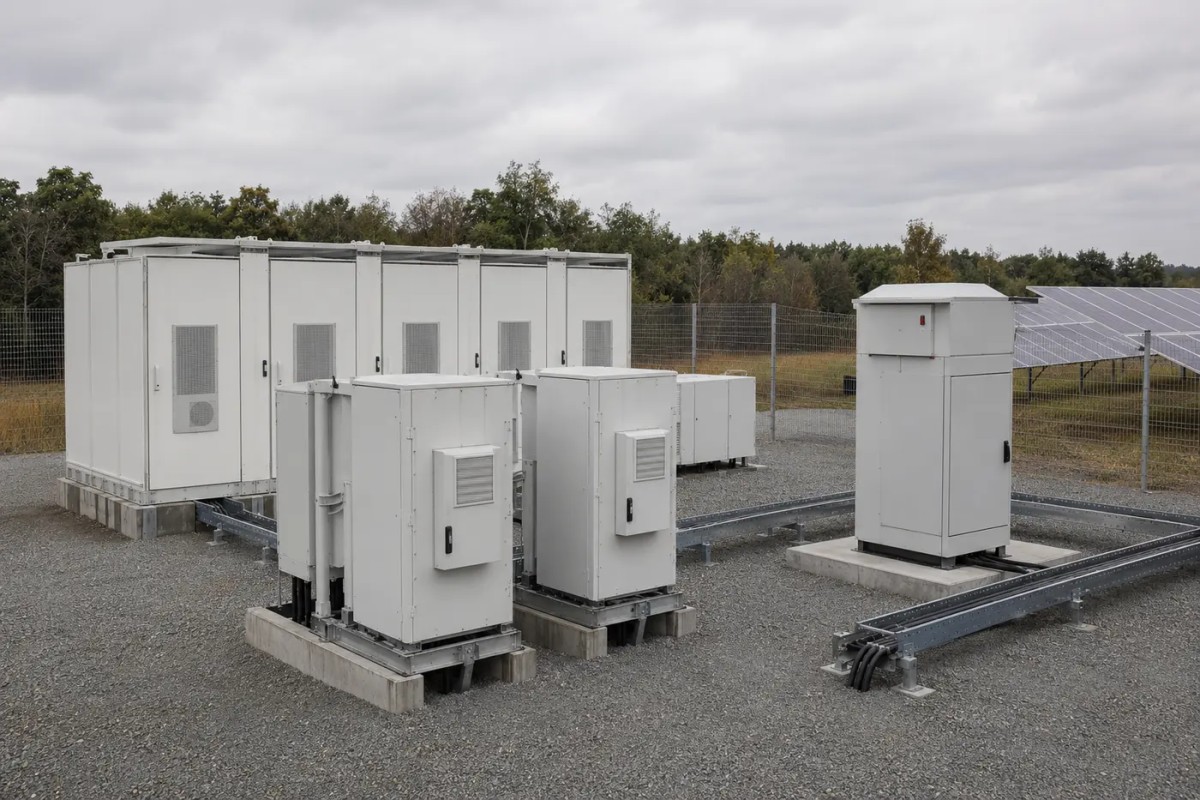
Inverter and storage equipment must be coordinated with the PV array, switchgear, protection system and grid connection.
Does Solar-Plus-Storage Work During an Outage?
It can, but only when the system is designed for that purpose. A standard grid-following inverter normally requires an established grid voltage and frequency. During an outage, it disconnects to avoid energising a circuit that utility workers may expect to be de-energised.
Backup operation requires suitable bidirectional or grid-forming capability, isolation from the utility network, coordinated protection, controls and enough battery power and energy for the selected loads. A system sized for peak-demand reduction may not have the duration required for extended backup.
What Determines Battery Runtime?
Runtime depends on usable battery capacity and the power demanded by connected loads. It is also affected by conversion losses, reserve settings, temperature, battery condition and control limits.
Critical loads should be identified before sizing. Lighting, communications and controls require far less power than electric heating, large motors or an entire production line. Separating essential and non-essential loads can make backup design more practical.
Key Questions Before Selecting Equipment
l Is the project new construction or a retrofit?
l What are the PV array voltage and target AC connection voltage?
l Is storage intended for energy shifting, peak control, backup or grid services?
l What battery power, usable energy and discharge duration are required?
l Which loads must operate during an outage?
l Are the inverter, battery, switchgear and control systems compatible?
l What environmental, fire-safety and local grid requirements apply?
System Design Matters More Than a Single Product
Inverters and batteries can improve how solar electricity is used, but their performance depends on the complete design. Equipment ratings, coupling method, protection, controls, ventilation, cable sizing, switchgear and grid requirements must be coordinated.
The most useful specification begins with the operating objective rather than a preferred product. Once the required function is clear, qualified designers can select an architecture and equipment combination suited to the site.
Planning a solar-plus-storage system?
Define the application, PV capacity, connection voltage, load profile, required battery duration and backup loads before selecting the inverter and storage equipment.
Get a message