




News and Information
Focus on Industry & Yuanfa Updates
Why a Solar Project Is More Than Panels: Cables, Transformers and Switchgear Explained
A complete solar project combines generation equipment with cables, protection, voltage conversion and power distribution.
Solar modules are the most visible part of a photovoltaic project, but they are only the starting point. Electricity must be collected, converted, protected, transformed and distributed before it can safely serve a factory, commercial building or utility network.
This is why photovoltaic systems, power cables, transformers, distribution boxes and switchgear should be designed as one coordinated system rather than purchased as unrelated products.
Solar Modules → DC Cables and Protection → Inverter → AC Distribution and Switchgear → Transformer → Building Loads or Utility Grid
1. The Photovoltaic System Generates and Converts Power
Photovoltaic cells convert sunlight into direct-current electricity. Cells are assembled into modules, modules form strings, and multiple strings create an array sized for the project’s required capacity.
The array output changes with sunlight, temperature, shading and operating conditions. An inverter converts this variable DC electricity into alternating current suitable for the building or grid. Modern inverters may also monitor performance and respond to voltage or frequency conditions at the connection point.
A photovoltaic system may be grid-connected, off-grid or hybrid. Hybrid systems can include battery storage, but the battery capacity, inverter configuration and control strategy determine what the system can actually support during an outage.
2. Cables Carry Power Between Every Stage
Cables are sometimes treated as simple accessories, yet incorrect cable selection can reduce efficiency and create serious reliability or safety risks.
DC-side cables
PV cables connect modules, strings, combiner equipment and inverters. They may be exposed to sunlight, heat, moisture and outdoor temperature changes. Selection should consider DC voltage, current, insulation, environmental resistance, installation method and voltage drop.
AC and medium-voltage cables
After the inverter, AC cables connect distribution equipment, transformers and the grid interface. Larger projects may use medium-voltage cables between transformer stations and a main substation.
Cable cross-section is not determined by current alone. Engineers must also examine route length, allowable voltage drop, short-circuit withstand, grouping, ambient temperature and termination requirements.
Practical point: connectors, glands, lugs and terminations must be compatible with the cable and equipment. A high-quality cable cannot compensate for a poor connection.
3. Distribution Boxes and Switchgear Protect the System
Distribution boxes, combiner boxes and switchgear control how electricity moves through the installation. Depending on system size and voltage, they may contain circuit breakers, fuses, disconnects, surge-protection devices, metering and control equipment.
Their main functions include:
l isolating equipment for inspection and maintenance;
l interrupting abnormal current and short circuits;
l protecting circuits against surge events;
l dividing power among different loads or feeders;
l providing measurement, status and control information.
l Protective devices must be coordinated. Breaker ratings, fault levels, cable capacity and equipment withstand values must be evaluated together so that the correct device operates when a fault occurs.
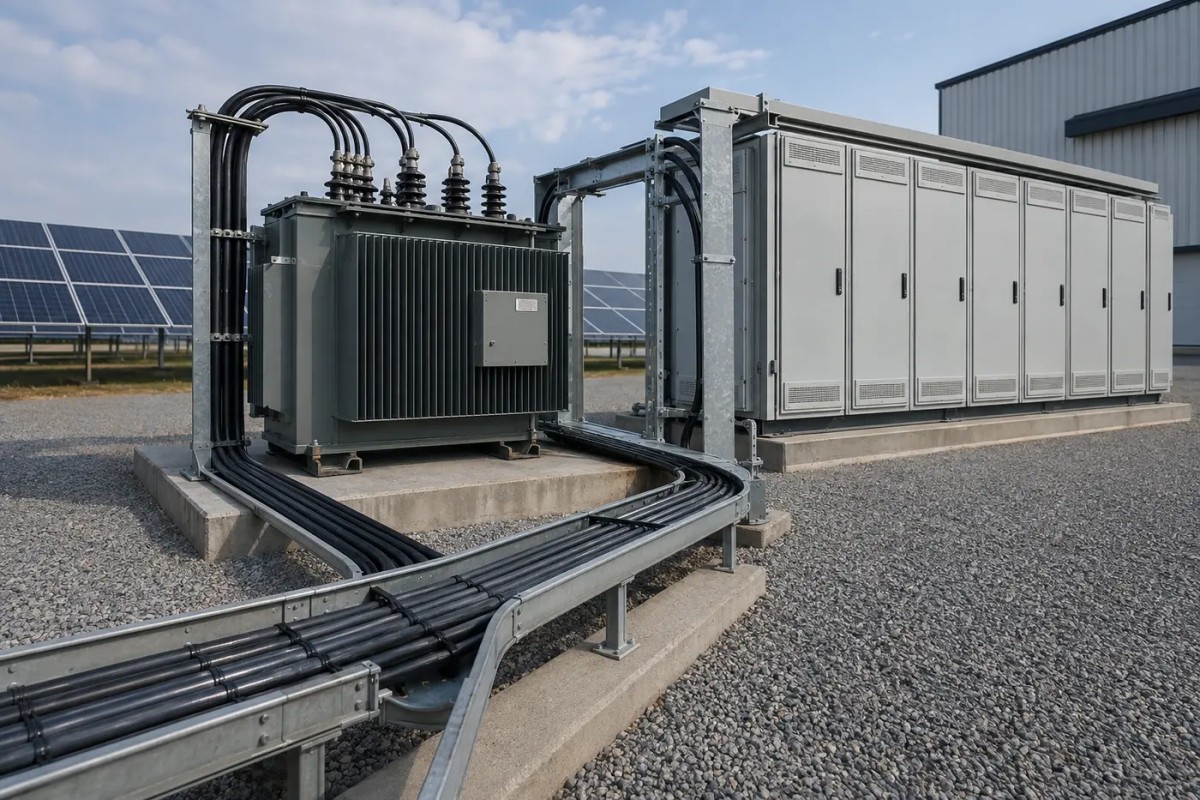
Power cables, transformers and switchgear form the connection between solar generation and the equipment or grid receiving the electricity.
4. The Transformer Matches the Required Voltage
Transformers change AC voltage. They do not convert the solar array’s DC electricity into AC—that is the inverter’s job.
A small rooftop system may connect directly at the building’s low-voltage distribution level. A larger commercial or utility project usually requires a transformer to raise the inverter output to a medium-voltage collection system or the grid-connection voltage.
Transformer selection considers rated power, primary and secondary voltage, frequency, vector group, impedance, cooling method, efficiency, environmental conditions and expected load profile. Dry-type transformers are often selected for indoor or fire-sensitive locations, while oil-immersed transformers are widely used in outdoor and utility applications. The correct choice depends on the project rather than one technology being universally better.
How the Four Product Groups Work Together
The equipment forms a chain, and each link affects the others. The PV array voltage must remain within the inverter’s operating range. Cables must carry the expected current without excessive loss. Switchgear must safely interrupt the available fault current. The transformer must match the inverter output, grid voltage and loading pattern.
A change in one product can require changes elsewhere. Increasing system capacity, for example, may require larger cables, different breaker ratings, additional switchgear sections and a higher-capacity transformer.
Common Project Mistakes
l selecting products only by rated capacity or lowest price;
l ignoring voltage drop and cable routing conditions;
l mixing incompatible PV connectors;
l failing to coordinate breakers, cables and fault levels;
l choosing a transformer without checking inverter and grid requirements;
l assuming every solar-plus-storage system provides full-building backup;
l leaving insufficient space for ventilation, maintenance or future expansion.
A System Approach Produces Better Results
A reliable solar project begins with the site, load profile, target capacity, connection voltage and local requirements. Product selection follows from these inputs.
Coordinating the photovoltaic system, cables, transformer and distribution equipment can reduce compatibility problems, simplify commissioning and support safer long-term operation. Final design and installation should always be completed or reviewed by qualified professionals using project-specific calculations and applicable standards.
Planning a complete solar power solution?
Provide the target capacity, DC and AC voltages, grid connection, installation environment, load profile and storage requirements before selecting individual equipment.
Get a message