




News and Information
Focus on Industry & Yuanfa Updates
AI Data Centres and Solar Power: A Growing Opportunity With Real Limits
Data centres can procure solar electricity, but reliable operation also depends on the wider grid, substations and other flexible power resources.
Artificial intelligence has created a new question for the energy industry: how can rapidly expanding data centres obtain reliable electricity while managing cost and environmental impact? Solar power and battery storage are frequently presented as part of the answer, but neither technology should be viewed in isolation.
The subject deserves a balanced assessment. Data centres are becoming an important source of electricity-demand growth in several regions, yet they remain a relatively small share of global consumption. Solar can supply significant energy at competitive cost, while continuous data-centre operation still requires a broader mix of generation, storage, grid capacity and backup systems.
What the Latest Data Show
The International Energy Agency reported that global data-centre electricity consumption increased by around 17% in 2025. Its base-case outlook projects consumption to reach about 945 TWh in 2030—roughly double the 2024 level.
Important context: the same IEA outlook estimates that data centres would account for just under 3% of global electricity consumption in 2030. Their impact is therefore significant in particular locations, but data centres are not expected to dominate total worldwide electricity demand.
Forecasts remain uncertain. Faster AI adoption could push demand higher, while improvements in chips, software, cooling and server utilisation could reduce the electricity required for each unit of computing. Actual growth will also depend on grid connections, equipment availability, planning approvals and investment.
Can Solar Power an AI Data Centre?
Solar can provide a substantial share of a data centre’s annual electricity, either from an on-site installation or through a power-purchase arrangement with a remote solar project. Its relatively short development time and widespread availability make it attractive for new demand.
However, matching annual energy consumption is not the same as supplying electricity every hour. Solar output changes with daylight, weather and season, while most data centres operate continuously. A facility that claims to purchase enough solar energy over a year may still draw electricity from other grid sources at night or during periods of low solar production.
Balanced conclusion: solar can reduce the amount of electricity that must be supplied by other sources, but a large data centre generally cannot rely on solar panels alone for uninterrupted 24-hour operation.
What Battery Storage Can—and Cannot—Do
Battery systems can store part of the daytime solar output and discharge it later. They may also help manage peak loads, respond quickly to grid disturbances and improve the use of constrained connections.
Battery capacity and duration are finite. Covering a short evening peak is different from supporting a large facility through several cloudy days or a prolonged grid outage. Long-duration requirements can increase project size and cost, so developers must compare batteries with grid reinforcement, generators, demand flexibility and other firm power options.
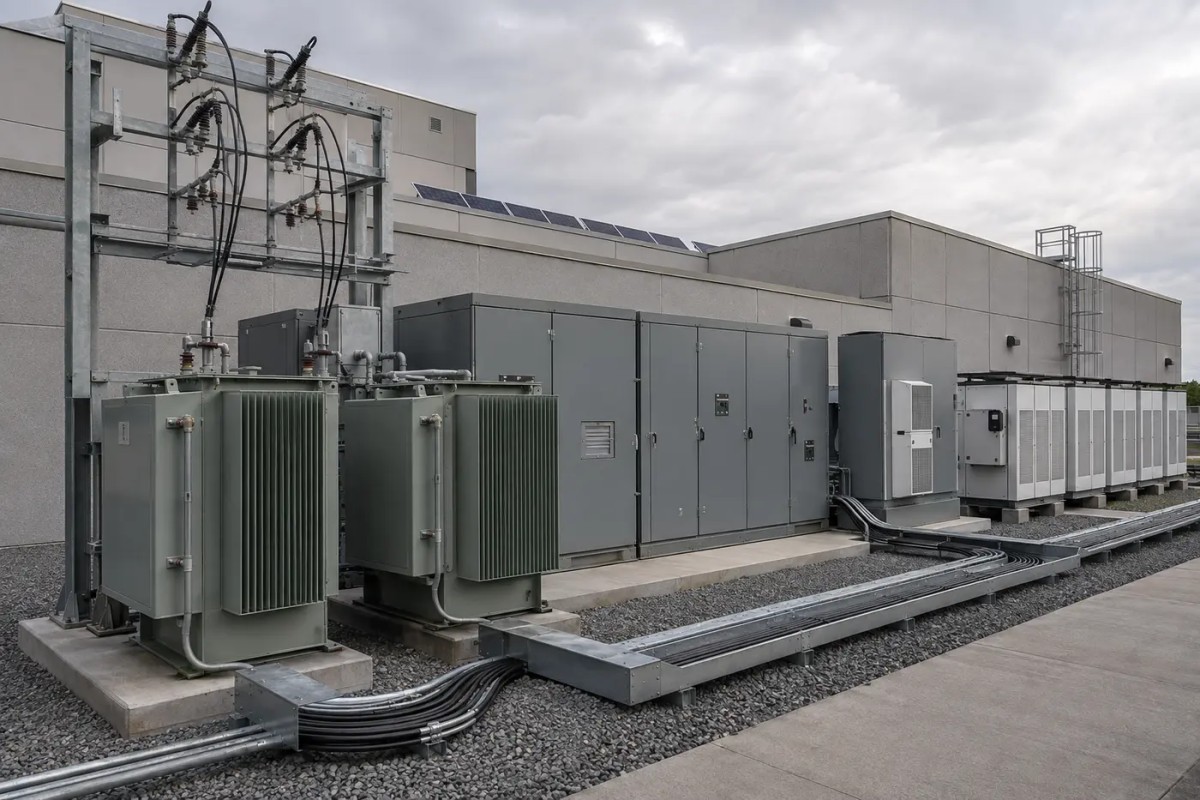
Behind any large digital facility is a coordinated electrical system involving transformers, switchgear, cables, protection equipment and backup capacity.
The Grid and Electrical Equipment Matter
The debate often focuses on the energy source, but connection infrastructure can be equally important. Large data centres may require new substations, transformers, medium-voltage switchgear, protection systems and high-capacity cables. Long equipment lead times and grid-connection queues can delay projects even when land, finance and computing hardware are available.
Location therefore matters. A site near strong transmission infrastructure and available generation may be easier to supply reliably than a site chosen only for inexpensive land. Developers also need to consider cooling requirements, water availability, local noise, land use and the effect of a large new load on other electricity customers.
Where Will the Electricity Come From?
The IEA expects renewables to meet nearly half of the additional global electricity demand from data centres through 2030. Solar and wind are likely to make major contributions, supported by storage and grid expansion.
Other sources will remain involved. Natural gas, coal in some regions, nuclear power, hydropower and geothermal energy may all contribute depending on local resources and policy. This means the emissions associated with AI infrastructure will vary considerably by country, region and time of operation.
A Practical Framework for Evaluating Projects
Instead of asking whether a data centre is simply “powered by solar,” stakeholders should examine more specific questions:
l How much electricity is matched with renewable generation annually and hourly?
l Is the solar capacity new, or is it reassigned from existing customers?
l What provides power at night and during low-renewable periods?
l How much battery capacity and discharge duration are available?
l Will grid upgrades affect cost, construction time or local reliability?
l Are efficiency, cooling, water use and backup generation included in the assessment?
Outlook
AI-driven data-centre growth creates a meaningful opportunity for solar, storage and electrical equipment suppliers. It also creates pressure on grids and raises legitimate questions about cost, reliability and environmental impact.
The most credible projects will avoid simple claims. They will combine efficient computing, transparent energy accounting, diversified power supply and properly engineered electrical infrastructure. Solar is likely to play a growing role, but its contribution should be measured as part of the complete system.
Planning power infrastructure for a high-demand facility?
System capacity, voltage, reliability targets, load profile and local grid conditions should be assessed before selecting transformers, switchgear, cables, solar equipment or energy storage.
Get a message